Author: admin

Mutual Funds – Statement Or Demat Format Of Mutual Funds: Which One Should You Go For?
When you buy mutual fund units, you can choose between getting your units in a statement of account (SOA) or in your demat account. Both forms are digitized; there are no paper certificates. But the demat units are held in your demat account with your depository participant (DP). Which one should you go for?
Buying on stock exchanges
In December 2009, when mutual funds first started being made available on stock exchanges, thanks to a ruling by the Securities and Exchange Board of India’s (Sebi), units were available only in demat format if you bought them from stock exchanges. But since the demand for demat units was low, Sebi eventually allowed investors to buy units in SOA format too, from exchanges.
Buying mutual fund units in the demat mode makes sense if you buy exchange-traded funds (ETFs) frequently. Since ETFs can only be bought and sold on stock exchanges, having a demat account is a must.
Transmission of mutual fund units (say, transfer of mutual fund units to a legal heir of a deceased unitholder) is easier with demat units. All the legal heir needs to do is open a new demat account in her name, submit the death certificate and a copy of the deceased unitholder’s Will and other required documents, and get the units transferred to the new demat account. If you hold units in SOA format, you would need to submit the documents to as many registrar and transfer agents (RTAs) and handle your various funds’ back office operations.
Where SOA scores over demat
Till about a year or so back, liquid funds were not available on stock exchanges through the demat mode. Now, liquid funds are available in demat mode, but you cannot buy and sell the units in a single day. Many large investors park money in a liquid fund for overnight duration only. If you buy liquid funds before 2pm, you get the day before’s net asset value. And if you sell the same units before 3pm on the same day, you will get money the next day, at previous day’s (today’s) net asset value. In the demat mode, the crediting of units and the subsequent debiting of units takes time since it happens at the depository participant’s end.
You can, however, buy a liquid fund in an SOA format on the stock exchange and then buy and sell the same day in the SOA format.
The operation is tedious for demat holdings, as units and money go through the stock broker’s pool account. The broker has to reconcile the accounts on a daily basis to segregate investors’ units and monies on a daily basis.
The delay and difficulty in reconciling the books on a daily basis is also the reason why daily dividend plans of liquid funds are also not available in demat mode. There is no such problem if you hold units in SOA format.
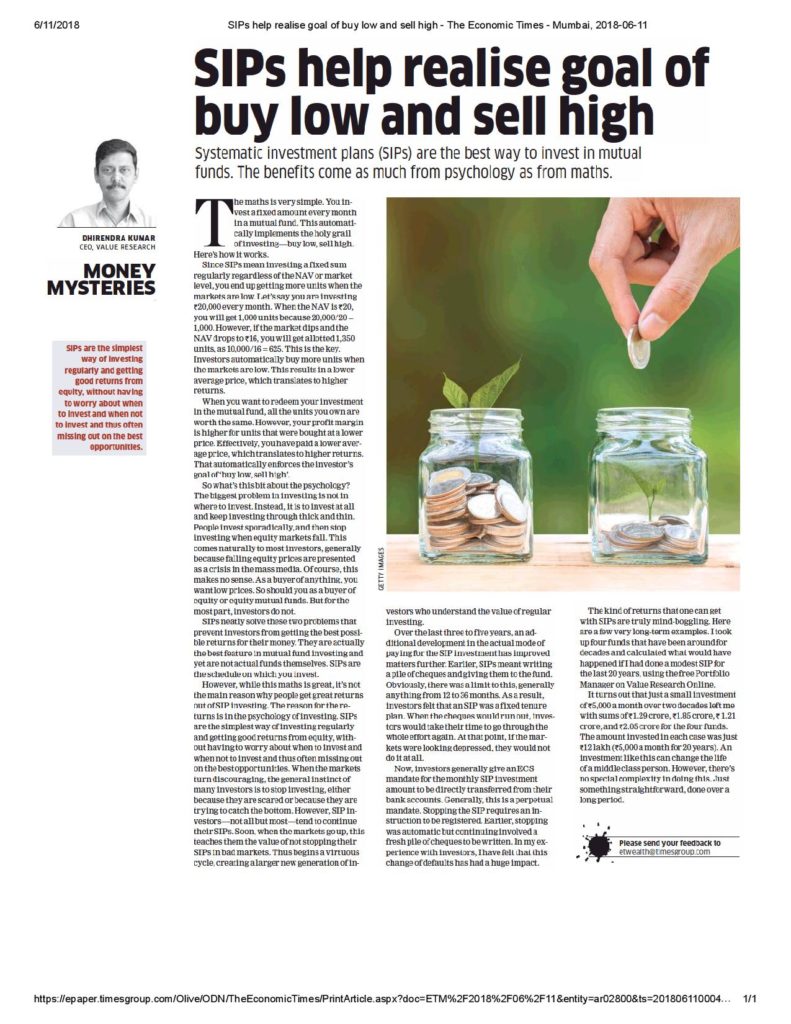
If you hold units in demat, you also cannot do a systematic transfer plan. Some brokers (on their own) offer systematic withdrawal plan, but not everyone. Systematic investment plans (SIP) and switches (between schemes of same fund house), though, are permitted in demat holdings.
Earlier, buying mutual fund units in demat form used to make sense if you already had a demat account and bought and sold equity shares of companies, as also bonds and non-convertible debentures. In that case, your demat account statement offered a consolidated view of all holdings. But from 2015, you get a consolidated account statement (CAS) for all your securities holdings, including mutual funds, irrespective of whether the latter are dematerialised or not.
An alternative to the liquid fund’s demat holding conundrum is a liquid exchange-traded fund. Here, you can avail daily dividend plans and buy and sell the same day.
Mutual Funds – Adjust Your Portfolio To Keep It On Track
A portfolio holds assets that earn different rates of return. Over time, the percentage of assets change, skewing allocation and risk, which triggers the need to rebalance
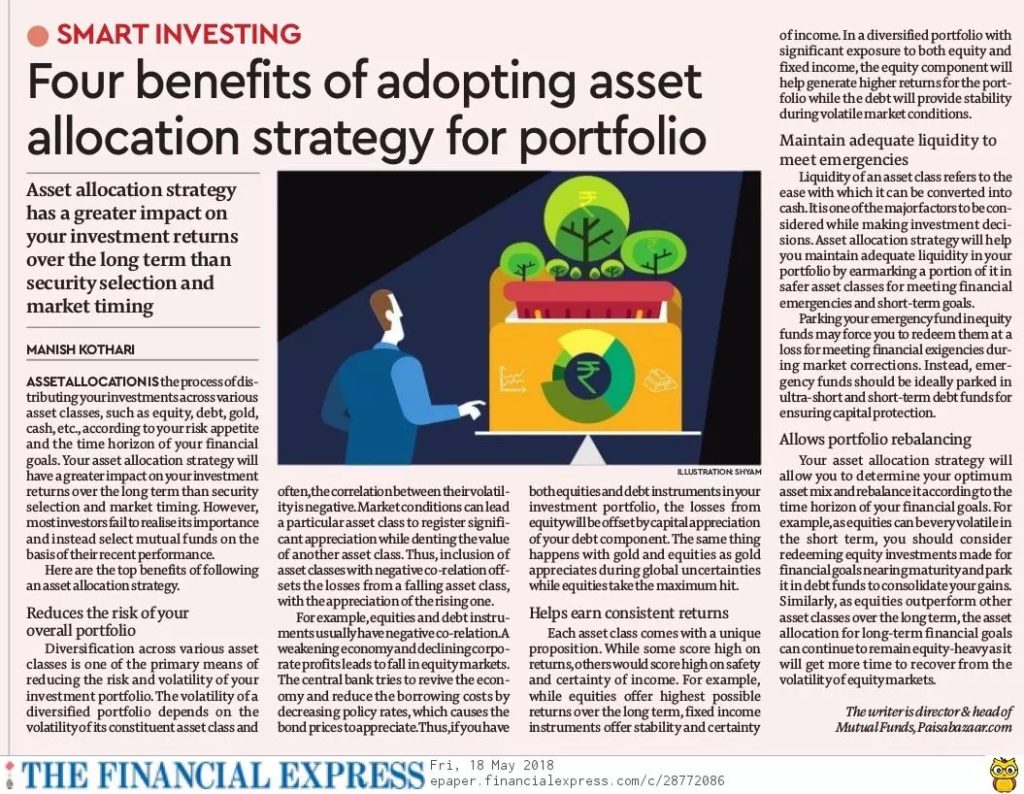
Building a portfolio to meet your goals is just half the job done. You also have to monitor and adjust it to keep it aligned to your needs. This is because a portfolio typically holds assets that earn different rates of return. Over time the relative percentage of the assets will change, skewing the portfolio in favour of the asset class that earns a higher return. The altered portfolio may then have a different level of risk. Rebalancing helps restore the original allocation.
Monitoring and rebalancing your portfolio is a continuous maintenance plan. You may need to adjust your current asset allocation as the terms to your goals change, or if your needs and goals themselves have become different, or if your ability to take risk is not the same anymore.
Work out the strategy
Just as you have a plan to invest, you need a strategy to rebalance your portfolio too. There are two aspects to the strategy—when and how.
You need to decide when and how often the portfolio will be rebalanced. One way to do this is to set a time-based schedule to rebalance the portfolio. You decide the time interval to the next rebalancing. This could be any frequency: annual, semi-annual, quarterly or even more frequent. While there is no best frequency to select, letting your portfolio drift for longer than a year may mean it is drifting away further from where it should be. If the rebalancing schedule is too frequent, it will imply costs, taxes and time. Rebalancing to a time schedule is usually simple to implement, helps keep knee-jerk reactions to market movements under control and prompts you to action when the scheduled date comes around.
Another method is to define a percentage change in allocation that will trigger the rebalancing. When the allocation to any of the asset classes changes by the percentage defined, then a reallocation takes place. In steady markets, the need for reallocation may be less, while in volatile markets the triggers may be more frequent. Set the tolerance range based on your ability to take risks. You should consider setting different thresholds for different asset classes or sub-asset classes based on the extent of volatility that each exhibits, and your own comfort in the asset class.
A third option would be a combination of the two strategies. For example, you could go for an annual review but effect a rebalancing only if the allocation has altered beyond a defined percentage. This combines the benefits of both the strategies. Since there is a time schedule for rebalancing, the chances of overlooking or procrastinating is reduced. At the same time, you don’t incur costs of selling and re-investing unless there is a significant shift from the original risk features.
Having a threshold that drives action ensures that emotions don’t affect decision making. In a rising equity market, you may be tempted to ignore risks and hold on to stocks, but triggering a threshold limit will make you think of the consequences and rebalance. Selling when markets rise also has the benefit of booking profits.
Once a rebalancing event has been triggered, the next decision you have to make is how to reallocate. The most intuitive way to do it would be to sell the asset class that has breached the upper tolerance level and use the funds to buy into the asset class that has lagged. The advantage of this method is that it is simple to execute, the reallocation is quick and you have the benefit of booking profits in a rising market and investing into another asset class when prices are low. The disadvantage could be the tax implication while selling assets and the costs incurred at the time of selling and buying. Be mindful of the taxability aspect while selecting the assets that are to be redeemed to rebalance. Look for benefits such as lower taxes on long-term capital gains, indexation benefits and setting off losses to reduce the impact of tax.
Another strategy would be to realign by investing all future investible funds into the asset class that is lagging so that its proportion goes up. Other cash flows from the portfolio, such as dividends, interest and maturity or redemption amount from investments should also be used to push up the holding in the under-weighted asset class. This way you will avoid taxes, and costs will be restricted to new investments. The drawback is that this method takes time.
Steps to rebalancing
Executing a rebalancing strategy effectively requires a system. The first step is to create a list of all the investments you hold and classify them so that you know your current asset allocation. Compare it with the asset allocation that was determined as the most suitable. Make changes to the allocation so that your portfolio reflects what you need. The preferred asset allocation may change if your goals have changed, thereby altering your risk and return preferences.
Having a rebalancing strategy imposes discipline, and helps you focus on your needs instead of market movements.
Mutual Funds – Money Matters After Retirement
With rising inflation, mutual funds score over post office senior citizen saving scheme (POSS) and fixed deposits for investments in a retirement plan
In India, social security support on retirement funding or provision of pension is very limited or non-existential. The government supports senior citizens by providing additional facilities, rebates and exemptions. But beyond that, senior citizens have to manage their expenses. Here are some of the challenges:
Retirement corpus
The corpus requirement should be planned and accumulated during the pre-retirement phase. On retirement, one of the important decisions is investment of the retirement proceeds. In case you don’t get a pension, the primary objective of this investment should be to generate cash flow to support regular monthly income for years and fund specific goals such as children’s higher education, marriage and vacation. When selecting an investment or saving product, you should consider monthly or quarterly expenses, after factoring in inflation. You must extend the corpus for longest possible time, taking the increase in life expectancy of retiree and spouse, specific goal corpus requirement, tax efficiency of the instrument and liquidity of the product into account.
Traditionally, senior citizens invest in annuity plans of insurance, post office senior citizen saving scheme (POSS), bank fixed deposits and tax-free bonds. With rising inflation, supporting household expenses with traditional instruments such as POSS or bank FDs may become tough. Mutual funds offer a good investment opportunity.
Investment of retirement corpus can be planned in three steps:
Step 1: You should have three to four years of household expense invested in liquid mutual funds. You can do a monthly or quarterly systematic withdrawal plan (SWP) to replicate the income requirement.
Step 2: Based on the risk profile and other goal requirements, invest the remaining corpus in a combination ofdebt and equity mutual funds. This asset allocation strategy should be scientific and not a random percentage.
Step 3: You should continuously monitor, review and rebalance your investments.
Medical expenses
In India, the biggest financial challenge for citizens is the cost of hospitalization and ever-increasing medical expenses, more so for senior citizens who are prone to age-related health issues. The best way to address it is by getting proper health insurance cover and subscribing to health cards. A good health insurance will cover any hospitalization expenses. On the other hand, newage products such as health cards give access to free OPD consultation, discount on medicines, home nursing and diagnostic services. Our research shows that 97% of middle-class families completely exhaust their savings in case of medical emergency. A health insurance cover will prevent such a scenario.
Inadequate corpus
If you own one or more assets, you can sell it to fund your retirement. You can also give it on rent. If you own only one property, you can opt for a reverse mortgage product. In reverse mortgage, a senior citizen gets a regular stream of income from a lender (a bank or a financial institution) against the mortgage of home. The borrower can continue to live in the property until his death.
Asset transition
It is important to secure your assets and ensure they are transferred according to your will. This can be done by writing a proper will as part of succession planning. The assets you leave behind can hold both financial and sentimental value, and you may want specific items to be inherited by a certain family member or relative.
Legal complexities arise when a person dies without a will. The challenges not only cost the family financially, but also emotionally. It is advisable to approach professional and qualified financial planner to plan for retirement.
Mutual Funds – Impact Of GST On Credit Card Charges, Mutual Fund Exit Loads
If you were stumped to read that you will now be paying goods and services tax (GST) on your mutual fund exit load, you are not alone. The frequently asked questions (FAQs) issued by the Central Board of Indirect Taxes and Customs (CBIC) reveals the impact of GST on some financial services.
The FAQs explain tax implication on various charges, penalty and fees such as “exit loads” charged by mutual fund companies at the time of redemption, additional interest charged for default in payment of loan instalments and charges for late payment of dues on credit card outstanding. Here is how GST will impact your investments and financial transactions.
Impact on mutual fund investors
In case of mutual funds, expenses incurred by asset management companies (AMCs) are factored in the net asset value (NAV) of the scheme on a daily basis. However, exit loads are not included in the total expense ratio (TER) and charged at the time of redemption based on the scheme you have invested in and the tenure of your investment.
Typically, exit loads are nil or charged at a nominal rate in case of debt-oriented mutual fund schemes, if the redemption is made within a short period, say, 7 to 30 days from the date of purchase. However, in case of equity-based schemes, fund houses typically charge exit load of 1% of the NAV if the investor redeems from schemes within 365 days from the date of allotment.
In the recent FAQ, it has been clarified that the exit load will attract GST. However, “the load will not increase for the investor as GST is included in the existing load levy. The scheme on the other hand will lose out as the exit load amount credited back to the scheme will be net of 18% GST,” said a chief operating officer of a medium sized fund house,who is not an official spokesperson for the fund house.
He said the fund houses made a representation to the GST authorities and the service tax authority about this. In that they requested the tax to be withdrawn, and clarified that this is not a service provided to the investor, it is in fact, a levy to deter investors from exiting too soon. Their request hasn’t been accepted and thus fund houses are going to pay GST on exit load, but the tax will be included in the load itself.
All fund houses do not have clarity on this yet. Another fund house that Mint contacted was unclear about this issue and its treatment.
Impact on credit card holders
The FAQs clarified that additional interest charged for default in payment of instalment of a loan and charges for late payment of dues on credit card outstanding be chargeable to GST. “Credit card outstanding may comprise retail spends, EMIs and/or fees and charges pertaining to the use of credit card. However, GST is not applicable to the entire outstanding on credit cards. It is applicable only to fees and charges levied on credit cards. For example, components like interest charges, late payment fee or annual fee attract GST as per regulatory norms. Currently, the GST rate applicable is 18%,” said Pralay Mondal, senior group president – retail and business banking, Yes Bank Ltd.
While the new FAQs have brought clarity with regard to the implication of GST in the financial sector, many people continue to be puzzled how exit loads or fee on a default of loan payment can be considered “services” and attract GST.