Mutual Funds – Explained: Mutual fund cash holdings

Every mutual fund scheme comes with a mandate to invest in certain type of securities. And at all times, as well. But every mutual fund scheme is allowed a tiny part of its portfolio in cash. This is allowed to meet redemptions or any ‘buy’ opportunities that the fund may come across on any day.

Usually, equity funds hold cash between 1% and 5% of a fund’s corpus, though some funds can hold as high as 7-10% of their corpuses in cash. Some funds prefer to hold larger portions of their portfolios in cash because their mandate allows them to hold high cash levels if—as per their analysis—good stocks are not available at desirable valuations. Few others like dynamic equity funds also hold higher cash if they feel equity markets are overheated.

Equity funds usually have low cash levels as these schemes are vehicles meant for long-term investments. Debt funds have a larger allocation to cash and cash equivalent instruments as investors usually invest for the shorter term here and therefore there is a bigger chance of redemption in debt funds. Whether or not a fund ought to hold cash is a subjective call. Here’s a list of funds with the largest cash levels.

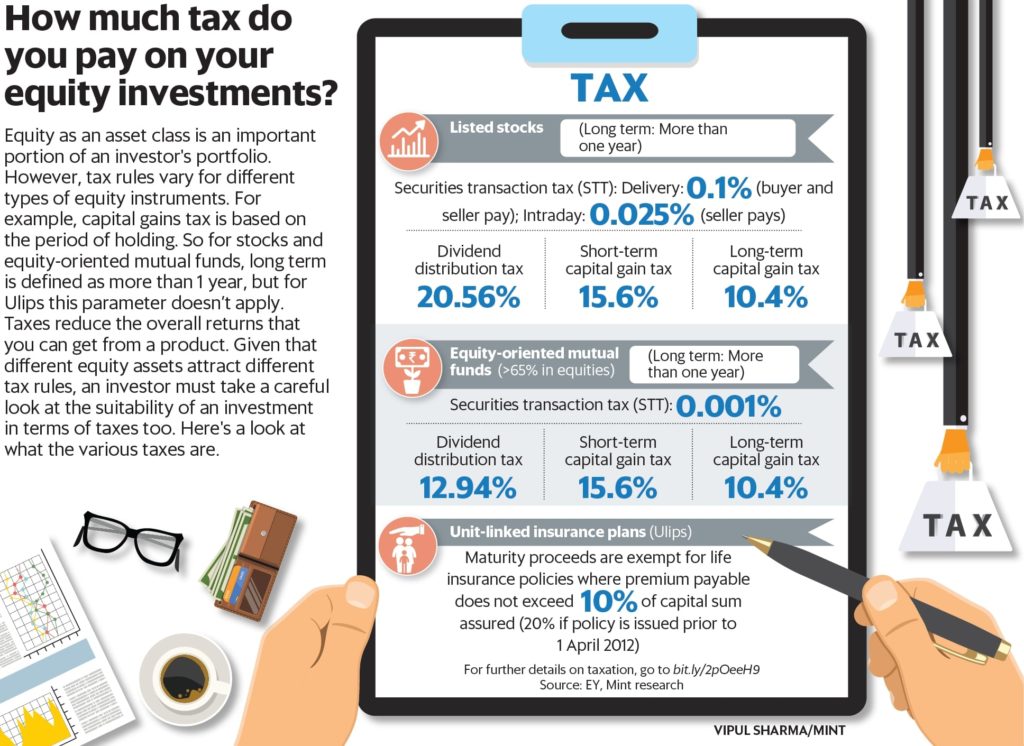
Mutual Funds – How Much tax Do You Pay On Your Equity Investments?

Equity as an asset class is an important portion of an investor’s portfolio. However, tax rules vary for different types of equity instruments. For example, capital gains tax is based on the period of holding. So for stocks and equity-oriented mutual funds, long term is defined as more than 1 year, but for Ulips this parameter doesn’t apply.

Taxes reduce the overall returns that you can get from a product. Given that different equity assets attract different tax rules, an investor must take a careful look at the suitability of an investment in terms of taxes too.

Here’s a look at what the various taxes are.


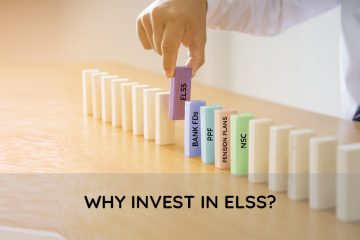
Why should you invest in ELSS

By now, most of you might agree that Mutual Funds Sahi Hai. You now probably know that mutual funds are a great way to build wealth, but did you know they are an even greater way to save on taxes? They are! Read on to know how.

Under Section 80C of the Income Tax Act, 1961, you can invest upto Rs. 1,50,000 in instruments like PF, PPF, ELSS, NSC, 5-year bank FDs, ULIPs, Senior Citizen Saving Schemes and more, to claim deductions on Income Tax.

At FundsIndia, we believe that Equity Linked Savings Schemes (ELSS), otherwise known as tax-saving mutual funds, are the best way to save on taxes.

Here’s why:

  1. Save on taxes: This is the first, and most obvious reason to invest in ELSS. You can claim a deduction on your income for the amount you invest in this. By fully investing Rs. 1,50,000, you can save upto Rs. 46,350* on taxes.

  2. ELSS can give you higher returns: ELSS or tax-saving mutual funds invest primarily in the equity markets and thus have the potential to deliver market linked returns. Most other instruments invest in government or corporate debt, or are deployed as banks and the government see fit. As a result, ELSS can perform better than these other instruments and give you a profitable edge.

  3. ELSS has the shortest lock-in period: When you compare the lock-in of instruments under Section 80C, you’ll see that the popular PPF has a lock-in of 15 years, NPS is locked-in until you’re 60, others have lock-ins of 5+ years, but ELSS has a lock-in of just 3 years! This means you’ll have access to your money faster and will also have better liquidity compared to other instruments.

  4. Tax-free capital gains and dividends: When you invest in tax-saving mutual funds, your income tax liability decreases. That’s great! But what’s even better is that you don’t have to pay taxes on your earnings from ELSS, whether through dividends or capital gains. Effectively, with ELSS funds, you save on taxes TWICE!

  5. Low minimum investment: You can start investing in ELSS funds with as little as Rs. 500. There is no maximum limit. You can continue investing as much as you want, in multiples of Rs. 500 (lump sums anytime) or set up a SIP and reap its benefits too.

  6. There are many ELSS options to invest in: The mutual fund universe is large and you can choose one (or some) from the many tax-saving funds to invest in. You are not limited by just one scheme or plan. Your FundsIndia investment advisor can help you pick the best tax-saving funds to invest in.

Get a head-start on your tax-saving today! Remember, the earlier you start, the more your money can compound, and you’ll also be free of last minute tax worries.

*Tax saving has been calculated for the highest income slab as per Section 80C of the Income Tax Act 1961, for the financial year 2017-2018.

DSP BlackRock Tax Saver

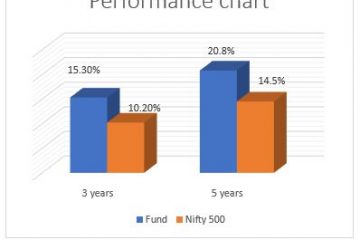
If you wish to invest for tax-saving purposes and are new to equity funds, then a less volatile, large-cap oriented fund like DSP BlackRock (DSP BR) Tax Saver can fit your requirement. An ability to contain downsides well despite staying fully invested in equity at all times and superior returns for relatively lower risk are characteristics that make this fund a good starter tax-saving fund. The fund delivered 15.6% returns compounded annually in the past 3 years. That is close to 5 percentage points over its benchmark Nifty 500 and about 3 percentage points higher than the ELSS category.

The fund and suitability

DSP BR Tax Saver is a go-anywhere tax-saving fund. It does not have any market-cap restriction, nor does it have a very specific strategy. It thrives by identifying opportunities at the right time. In that regard and in terms of its portfolio make-up it is not too different from its sister fund DSP BR Opportunities(which is a regular diversified equity fund). DSP BR Tax Saver has, however, remained mostly large-cap biased.

This fund is suitable if you are looking for tax-saving options with limited volatility. If your risk appetite is low, Franklin India Taxshield may be a better option as it remains large-cap focused. DSP BR Tax Saver does not have any such market-cap restriction.

Investments up to Rs 1.5 lakhs per annum in this fund will fetch you deductions under Section 80 C of the Income Tax Act. The Rs 1.5 lakh limit is part of the umbrella deduction allowed for all other tax-saving products. Investments are ideally done through the Systematic Investment Plan (SIP) route to avoid mistiming the market.

Performance

DSP BR Tax Saver has, over the last few years, improved its record of delivering consistently. When its 1-year returns were rolled daily, over the last 3 years, it outperformed its benchmark, the Nifty 500, 96% of the times. Over the same period, on 9% of the occasions, the fund had negative 1-year returns. The benchmark delivered negative 1-year returns 20% of the times. This shows that the fund not only outperforms in rallies but contains downsides better.

A similar exercise (1-year returns rolled daily for 3 years), compared with peers shows that the fund outperformed the category average 73% of the times. While there are funds from the Aditya Birla or Tata houses that have bettered this record, that was possible primarily because those peers came with a much higher mid-cap exposure (almost 50%). DSP BR Tax Saver, on the other hand, had an average large-cap holding of 70% in the last 2 years. In other words, its absolute returns were not as high as some peers as it did not take higher risks. The fund actually managed superior performance with lower risk (as measured by Sharpe or risk-adjusted return) when compared with the same peers.

DSP BR Tax Saver's Holdings as of November

That said, there will be times the fund underperforms. Oftentimes investors look at point-to-point one-year returns to make investment decisions or to review their funds. Here’s an example why this is not a good idea, especially in funds such as this one: Just look at the chart below. The 1-year returns of the fund on multiple dates is given below. If you had seen the returns in August, it might show that the fund outperformed its category average. But if you had seen it in October, especially post the bank recapitalisation announcement, the 1-year returns will suggest that the fund is underperforming. While the fund per se managed to deliver higher in the past month’s bank recap rally, its peers outperformed it, given their higher midcap holding. Thus, if you looked at just the point-to-point returns of the fund in the past few weeks, it might seem like it is an underperformer. Another large-cap peer Franklin India Taxshield too showed a similar trend.

Funds' 1-year returns can vary drastically on a day-to-day basis

The point we are trying to make is: First, short-term 1-year returns can often be misleading. Funds may have periods of short blips and see dips in performance but pick up later. Second, point-to-point returns can change drastically within a matter of weeks. As an investor, you will do well to look at longer periods of consistent performance. At research, we do this by watching rolling returns over longer periods to measure consistency. But at the same time, we are not oblivious to short-term returns. We watch for rolling 1-year returns too. If a trend of underperformance or outperformance prolongs, then we check the reason for the same.

Portfolio

We mentioned earlier that DSP BR Tax Saver does not appear to have very fixed strategies in terms of growth or value or any theme of cyclical or consumer focused. Also, given its large-cap focus, there is little scope for the fund to ‘discover’ stocks. It rather relies on its timing themes and individual stock picks. It appears to be picking themes or stocks just ahead of up moves and actively book profits. For example, the fund picked metal stocks Tata Steel and Vedanta in 2016, when the commodity uptick started. In terms of individual stocks too, it picks stocks just in time, for example, Larsen & Toubro was picked just as it hit the bottom in February 2016, after a sharp fall in 2015.

DSP BR Tax Saver's Holdings as of October

However, there have also been stocks like SBI or Bank of Baroda which it pruned, only to miss the up-move post recapitalisation. Those opportunity losses are inevitable in funds that make tactical moves. That the fund very actively manages its portfolio is visible in its high portfolio turnover ratio; far higher than funds such as Franklin India Taxshield or Invesco India Tax Plan. That the fund still manages its returns with low volatility despite high portfolio churning is what makes its performance distinct.

The fund is managed by Bharat Bagla.

Bees Network’s Research team has, to the best of its ability, taken into account various factors – both quantitative measures and qualitative assessments, in an unbiased manner, while choosing the fund(s) mentioned above. However, they carry unknown risks and uncertainties linked to broad markets, as well as analysts’ expectations about future events. They should not, therefore, be the sole basis for investment decisions. To know how to read our weekly fund reviews, please click here.

Contingency fund and its importance

Your EMI is well within your capacity, you have no difficulty in meeting recurring expenses, and you even have a monthly surplus that you’re investing. Isn’t that a great position to be in? Well, yes. But there is one thing that you have missed out on. And that’s a contingency fund. Let’s see why it is important to have a contingency fund and how to go about maintaining one.

What is a contingency fund?

Contingency fund is the money you set aside for any unforeseen event that will disturb your financial stability. This could be a temporary stall in your regular income, say, due to a loss of job or change in job where you will have to go a few months without your salary. Or any unexpected large expense (like a medical emergency which your insurance won’t cover) that might affect your finances for months together.

Why do you need a contingency fund?

An emergency-like situation that requires a large spending on your part will immediately hit your finances. For example, natural calamities like a storm or flooding due to rains can damage your household goods which would need replacement. Circumstances such as loss of a job, or a few months without pay between jobs can have a similar effect.

So what happens? It might leave you unable to meet any loan obligations or even your monthly expenses. Or, you may find yourself unable to even meet that large expense requirement, requiring you to take a loan in order to pay for it. This in turn increases your monthly expenses for some time. And apart from potentially hurting your ability to meet your payments, it can also eat into your savings for future financial needs.

You could make arguments against the need for creating emergency funds. Let’s look at some:

1. I have a secure job (and I always will) – Even though salaried individuals enjoy a sense of security, some amount of uncertainty always persists. For those who have fluctuating monthly incomes, such as freelancers or self-employed, the lack of fixed certainty in cash flows makes it more important to have a contingency fund. There could also be times when your regular income is not sufficient to meet the emergency needs.

2. I have assets that I can bank on – Liquidity of the asset will be the main concern during a contingency. You might think that your house that’s worth a hefty amount of money or other investments will have you covered but unless they can be converted into cash immediately and without causing you a loss, they wouldn’t serve the purpose. So while you could withdraw your fixed deposit, you may pay a penalty. Taking out your provident fund money is a time-consuming process and comes with conditions. Selling your house is hardly an optimal choice. Remember that dipping into your other investments would also take you off your wealth building track and disturb the plan with which you would have made those investments.

How much should you have?

Cont_image

Ideally, your contingency fund should cover at least six months of your expenses. Components of expenses that you should include are EMI payments, insurance premium, utility bills and other recurring household and living expenses.

For some, this might seem like a huge amount to be built at once. But it isn’t necessary to build it at one go – you can do so gradually over several months. For instance, you could put however much you can today and top it up as and when you have a surplus. You don’t also need to prioritise building your contingency fund over building your wealth. You can do both together. Simply take out small portions of your regular monthly investments until you have your corpus done. If you haven’t started regular investments yet, set up a contingency fund first.

Once built, review it every two years or so to ensure it still matches your changing expenses and inflation. If you withdraw from it to meet any expense, top it up as soon as you can.

Where do you park your contingency fund?

Keeping in mind the purpose of a contingency fund, the aspects to look at are liquidity and safety. Returns are not the most important factor, but is also worth considering as a final point. The options that fit these criteria are savings account, fixed deposit, liquid funds, and ultra-short term funds.

Of these, a mix of your savings account and a good portion in liquid funds works well. Since your contingency fund will be lying around for long periods of time, this will allow you to get the required liquidity and safety but still eke out some higher returns. You could also include some ultra short-term funds – while these are slightly riskier, they deliver higher returns and risks mitigate on holding beyond 6 months to a year. But take care in selecting ultra-short term funds as a few of them invest in low-quality debt which ups the risk factor.

Here’s why the mix above makes sense:

1. A savings account is the most liquid, as you can withdraw the money immediately. Redeeming from liquid funds is also easy, and you will receive the proceeds within 1 business day. Liquid funds don’t have exit loads either. Ultra short-term funds may have exit loads; redemption proceeds can also take a couple of days to land up in your account, so put a smaller portion here if you’re using them. Note that if you do not have the discipline to maintain a minimum savings account balance, it’s best to put more into liquid funds.

2. Liquid funds usually deliver returns higher than savings bank accounts. Liquid funds also stick to high-quality debt papers and don’t deliver even 1-day losses (barring extreme and rare circumstances). There isn’t any tax to be paid until you actually withdraw, so your money compounds much more. Savings bank interest (over Rs 10,000 a year) and fixed deposit interest are necessarily taxed each year, increasing your tax payouts and hurting compounding for your investment.

3. Capital gains on liquid and ultra short-term funds are taxed at 20% with indexation benefit on holding for more than 3 years (taxes are at slab rates for a holding period shorter than this). Regardless of holding period, savings account and fixed deposit interest are taxed at slab rates. Therefore, your eventual tax impact may also be lesser with liquid/ultra short-term funds.